Two Voices: Travelling the Worlds with Fernando Varela

Divided into two parts
My soul is in confusion:
one, a slave to passion
and another, to the measured ratio.
Sor Juana Inés de la Cruz
Traveler, there is no path, the path is made by walking. […]
Traveler, there is no path, only wakes on the sea.
– Antonio Machado
The duality of reason and passion is as intrinsic to human beings as form and content are to art. Dominated by two poles, as if by a magnetic field, human life and creation are a journey, a bidirectional pendulum swinging between the two. Fernando Varela's work is full of dualisms and dualities. This is affirmed by the sole possible author of the constructions, paintings, sculptures, prints, and installations that, in retrospect and above all introspectively, encompass 40 years of artistic production in this exhibition. A Uruguayan artist who, nevertheless, has long been also Dominican, his work is inseparable from his self or—why not correct ourselves—from his me. Metaphorically expressed in her work, as metaphysical as it is plastic, in contrast to the religious and culteranist poet in whose work the cult of the formal determines the substance, in hers it is the concept, the idea or the essence, the axis and starting point of her many formal and technical journeys. Varela's art is container and it is empty; Fernando is his work and his work is a ship.
First transit. Land Sea
Fernando Varela revels in the dual perspective and the joy that being able to see himself from both within and without brings to an artist. Hailing from the vastness of the mainland, he arrives in a land fragmented and adrift, surrounded by the infinity of the sea. Upon his arrival from the south to these waters, he unfolds his cartography of the soul, like a traveler seeking to ascertain that he has reached his existential destination. Carried in an ancestral suitcase—made of pulp and leather, of ancient parchment and paper—he also carries with him original blocks—steps of primordial wood and clay—serving as footings and compasses. Within a framework of a constructivist lexicon of material and form, as well as symbols and codes that profess an unknown spiritual language, Varela's primary work is a combination of sculpture and painting. While an austere, earthy palette is a prevailing southern reference, the color of the Caribbean's already well-trodden blue immensity also emerges.
In the early series of Constructions, Readings y Sacred, A set of grids and horizontal registers, both precise and irregular, largely underlies and organizes the composition. Species of blueprint The cyanotype, which in a diversity of solutions, including the cruciform, will permeate all his production, is a map and plan in which the radiographic tracing of a cardo and decumanus can also be read, which, having the artist at its center, offers in a multiplicity of ways new possibilities and transits to his intertwined and concatenated creation.
Varela speaks of revelations when referring to his driving force. And these do not exclude those that appear as an accident or even as a product of some limitation. He abandons, for example, ceramics – a technique visible in the pieces from '88 (Untitled. Oil, wood and ceramic), from '83 (from the series Constructions: Construction. Oil, wood and ceramics), and from '82 (from the series Constructions: Construction. Mixed media and ceramics) – because clay does not agree with its consistent propensity for large formats, but also because of the lack of an electrical infrastructure in the Dominican Republic that could support its firing. However, he did not entirely abandon the medium of his early training. Turning to oil paint and, with it, to an approach to trompe l'oeil, he imitated the quality and textures of clay, as well as those of papyrus and parchment, in canvases such as Exaudi Orationen Meam Domine and the one from the series Sacred, both from the year 1984.
In art, Fernando Varela affirms, each concept demands, or rather, finds its own particular means of expression. Clinging to a philosophical understanding of the transcendence of being beyond all corporeality, which he undertook to gather in his native country from a very early age, his quest led him to creation as a vehicle for understanding and communication. Many claim that Varela became an artist in the Dominican Republic, that it was here, not elsewhere, that this culmination occurred. In his physical displacement and his encounter with a new identity, the influence of the Southern School is a natural stylistic cadence of his original environment; a strong initial foundation that, with the passage of time, becomes sediment, increasingly diluted in the fluid and confluenced environment of his new home.
Second Transition. Carnal Spiritual
While the spiritual component, always present in Varela's work, was primarily a latent foundational element in the first part of his career, once he had mastered the medium and his craft, the materiality of the artwork became, above all, a body and vessel mediating between the tangible and the immaterial. In this process, the human body—a figuration distant and distinct from his previous and dominant abstraction—becomes a point of reference in its dual condition as subject and object, or instrument for creation, ultimately mutating into a symbol and thus, through numbers and letters, reaching another level of non-objectivity. Similarly, more tangible references to the work of other artists who influenced him emerge, and political commentary becomes palpable, while in the figurative representation of the Antilles and the flora of the insular Caribbean, eroticism becomes more literal. Fernando Varela navigates between the carnal and the spiritual in his work without denying his physical corporeality, and therefore without neglecting his continuous formal exploration.
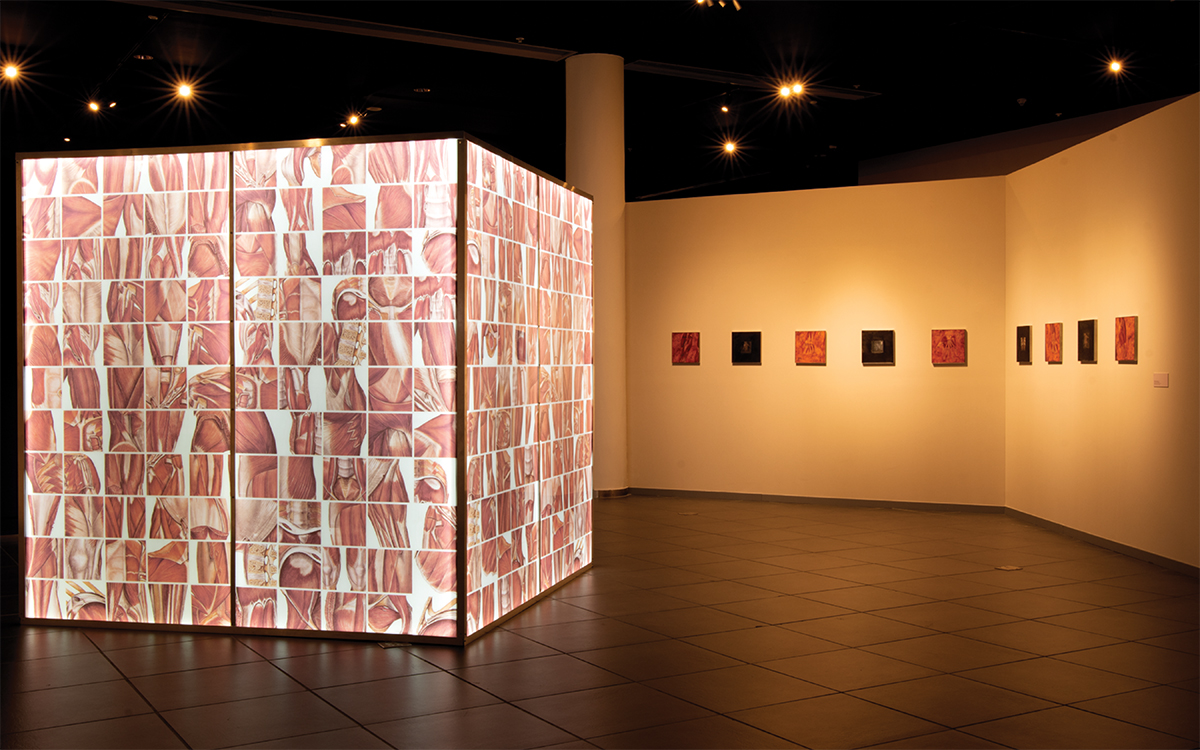
The paintings and collages with which he pays homage to the transcendental and highly transgressive German artist Joseph Beuys (1997; 2000 and 2015), the sculptures in the round De profundis y De profundis II (1999), the installation The Healing Room (2001) and the polyptych on photographic paper Story of a Passion (2001) are corpus of the human body and its parts, through which he delves into the ethereal search for the ulterior. The installation format, with which he also appeals to the sense of smell through camphor in his “healing room,” allows him to go further, also including the corporeal presence and interaction of the viewer in his inquiry and composition. This group of works in the exhibition represents an exceptional chapter in Varela's artistic journey, both for its conceptual quality and technical mastery, and because, viewed within the broader context of his production, it stands out as an exception. Dominant in almost all of these pieces, photographic reproduction, for example, acquires its almost exclusive presence. But the difference is also only apparent, because when we delve deeper, we discover in most of them the cross, the grid, the quadrilateral, and the oval shape as a visceral framework.
In a double game that oscillates between the skills of the healer and the curator, "The Room That Heals" alludes on the one hand to the healing and saving capacity of art, which on one side proposes a Beuys, and is complemented by the polyptych that, on the other hand and in clear allusion to the Passion of the Savior, deals with the artist who is willing to be a martyr of his own creation. A visual account of the terrible physical damage Varela suffered hammering metal type onto canvas and paper is another kind of sacrifice that seeks healing. Furthermore, the installation, recreated for this occasion but originally presented in the context of "Curator Curated," that revolutionary exhibition hosted by the Museum of Modern Art and self-managed by Varela along with artists Quisqueya Henríquez and Jorge Pineda, is a political statement on the critical situation of the figure of the curator, as defined by the institution's official structure.
Large-format sculpture also comes into play here. America, double and useless scissors that undermine the well-known usefulness of the object it seems to represent. In a closed and knotted circuit, it points without points to the intricate and unresolved political situation of a continent lacerated by its colonial past, as well as to the futility of the act that attempts to unravel it. A giant X, whose continuous linear sinuosity traces a region tattooed by transit in a network of meanders, also serves as a great marker of the American Caribbean, the arena from which the artist makes his commentary.
Reflecting all of this, one could say, are also the later works of The journey (2010 and 2010-2019), Alternative spaces (2007) and Fragile dreams (2005 and 2007), pictorial series in which figuration remains evident and which point to the highly political, forced, and coerced displacement of our people. Confined and bound bodies appear, or bodies with severed legs and arms that iconize The lost and the unconsummated, while a germinal repertoire of brains, of dual ovals or hemispheres that unite in their center, and of sheaths and branches, some phallic and others reminiscent of the sex of the original mother, are added to the thesaurus betting on the opposite. Locus amoenus y terribilis, Of the two, it is the Caribbean, with its fertile life and abundant creation, that flourishes in Varela's work. In recognition of its prolific nature and its multiple identities, the series Caribbeans –with an s– of large and colorful oil-painted canvases, is his best display. Imaginary image of enchanted forests from whose ears of corn sprout the islands of this Antillean enclosure in a forest of vulva-like leaves and penis-like fruits, The dream by Rousseau and The jungle Lam's are also present there.
Something similar can be observed in a parallel series he produces for the same dates, which, however, is surprisingly different at first glance. The unspoken word Masculinity and femininity, as conditions of existence, are encoded in numbers and letters respectively. As if wanting to engrave it in stone, he "chisels" paper and fabric in an internal exploration of both being and technique. That's what it suggests. Sky/Sea, An oil on canvas from 2006, whose ascending central axis challenges the horizontality of the point where both planes meet, opening the way to otherworldly transcendence. The palette of cobalt blue and turquoise that the geographical location best reveals is muted in a sister work from the same year and style, such as The Silent Word XII. The white and supremacist matrix, which in its clear nod to Malevich elevates us to the existential stratum, demands, along with its companions, the silence and contemplation that only these words can make speak.
Third Transit. Cosmogony Morphologies
Confronted with the worlds of his creation, Fernando Varela believes that it is the latter part of his work that, among all its parts and among itself, achieves and reveals the greatest interrelation. In this gathering of mirrors, we see numbers and letters, the record and the fragmented plane, the spectrum of the diverse color palette, and, above all, the seminal form of the oval and the egg as a reproductive organ. A duel of reconciled opposites from which all creation germinates, it is a metaphor for the Universe, as well as a glossary and an exploration that investigates the possibilities of the same form in all its means of expression and adds new spheres to his production. A fortuitous return to collage, which gives sculpture greater force, paving the way for mobile art and from there to the kinetics of video installation, is part of the lexicon with which this artist's work is grounded in total abstraction. Just as Cézanne – the true father of abstract art, according to Picasso – gave continuity to the historical feat of art when, having "resolved" his formal problems, he proposed more, so Varela continually problematizes his work so that it can continue.
In the series of Origins y Primary forms We recognize its earliest forms in lineage of blow-up. This grandiloquence, resolved in textured painting of broad fields of color, while including the ovoid form that enhances the whole, which Brâncuşi best consecrated in modern art, This refers primarily to the initial influence the artist acknowledges he received from Abstract Expressionism, when he traveled to New York shortly after arriving in Quisqueya. While the works in the second series are influenced by the style of Robert Motherwell, more specifically, it is the introspective quest of the so-called New York School that serves as the common denominator and will continue to consistently drive Varela's creative work.
For Fernando, only by looking within ourselves can we find God. Almost infinite, like this one, the series Form and emptiness It is the discovery of a revelation that, acting as his most copious production, also leads to Interiors, Fragmentations y Close-ups. A collage sparked the vision when his daughter, as a child, gifted him a composition in which her amorphous oval shapes appeared cut out in pairs of positive and negative images alongside the hollowed-out area of their removal. In this innocent creation, later recreated by the artist, as demonstrated by the 2013 piece that lends its name to this great series of series, he perceived the visual equivalence of the Universe and its Creator. Two things that are one and the same; in this he also observed the duality of being, that of body and spirit in its most familiar sense; and he soon migrated his existential and formal dilemma to the corporeality of the third dimension.
Limited by a family health situation, and unable to paint, Varela began to cut out cardboard and model sculptures that he has described as "flat". Made of stainless steel and eventually Cor-Ten, the germ of their plastic conception explains why some of the early pieces suggest the flatness as well as the lightness of paper. But the most literal translation of those cut sheets to another medium is found in the mobiles made of large sheets of Sintra wood, which, suspended with their respective pairs and inviting us to play, seem more like recreating a dance. Impossible to ignore, Varela perceives and embraces the inescapable—even unconscious—impact of the cutouts or cut-outs by Matisse. These window-panels, also monumental, through which we can see ourselves, however, pay more homage to the cardboard that, casually thrown onto a painting in the studio, was also a happy accident that, in the form of a frame, revealed new approaches and possibilities.
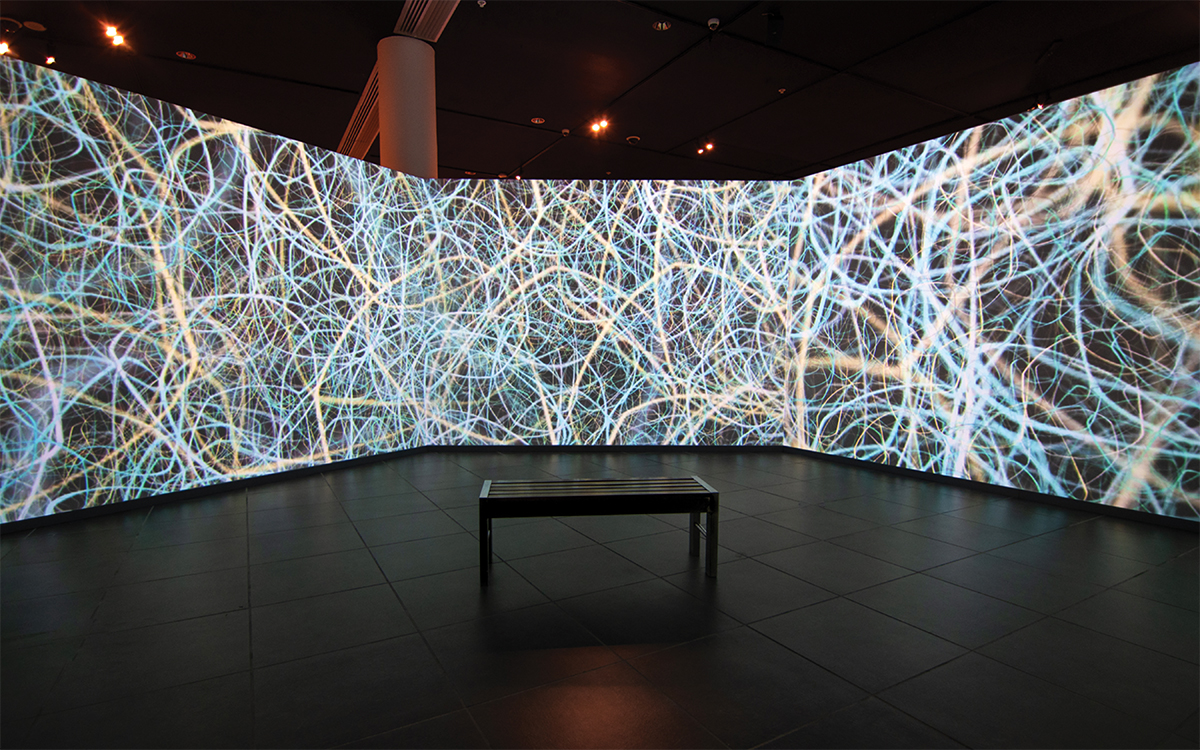
Approaching Varela's work in this way reveals his spatial investigations, those of light and transparency, present not only in his close-ups (2020 and 2021), but in its mirrors (2020) and fragmentations (2018 and 2019), in a painting and installation as The curvature of space (2019; 2022) and in its interiors (2017 and 2018). Also begun on the significant date of 2020, which in turn marks the beginning of the pandemic and its lockdowns, her most recent series seems to be an approach to the approach; an enormous petri dish where a culture of countless original forms seethes in an apparent stage of birth. However, Worlds It is also recognition, a pause, and a distancing that, looking from the vastness of the space, suggests that ours is not the only reality, nor are we the only center. Entering the audiovisual installation, on whose large-scale screens we see projected its concatenation of patterns that, floating in transitioning colors, pass through us while our silhouette is projected onto them, is to recognize ourselves as just another particle. As in The unspoken word, In this sort of Rothkian chapel with sound, the invitation is to be silent, to stop and look inwards.
Colophon
As the great Machado said, the path is only revealed to us as we travel it. Looking back, this retrospective is a path paved by four decades of continuous journey. And these words I share here are the result, and also the privilege, of having traveled it alongside Fernando Varela, on the path to a world of works that—born in the insular Caribbean—are a legacy and a paving stone in the sea.