Fernando Varela, excellent retrospective at the Centro León

There are exhibitions that teach, that question, that move you
With this exhibition, “Worlds, the Transitions of Fernando Varela”, no one can remain indifferent to the totalizing sense of Varela's work and its enriching reading, following the stages of his creativity, inspiration and craft, which have always been nourished by spirituality, omnipresent and still conditioning.
He was a follower of a German intellectual and artist with a complicated surname, better known as Bo Yin Ra. In his paintings, sculptures, ceramics, drawings, and installations, we find the precepts of this master, who was multifaceted in the arts (including music, like Fernando Varela himself): he affirmed that the best spiritual exercise was to perform one's daily tasks consciously and live life with quiet optimism…
In our opinion, this same message emerges from the life and work of Fernando Varela, arranged by him and the institutional curatorship, in several spaces, two floors and three phases:
- Matter Physical-spiritual world (1982-1999)
- Physical-sensitive body (2000-2010)
- Spirit World Energy (2011-2021)
The Exhibition
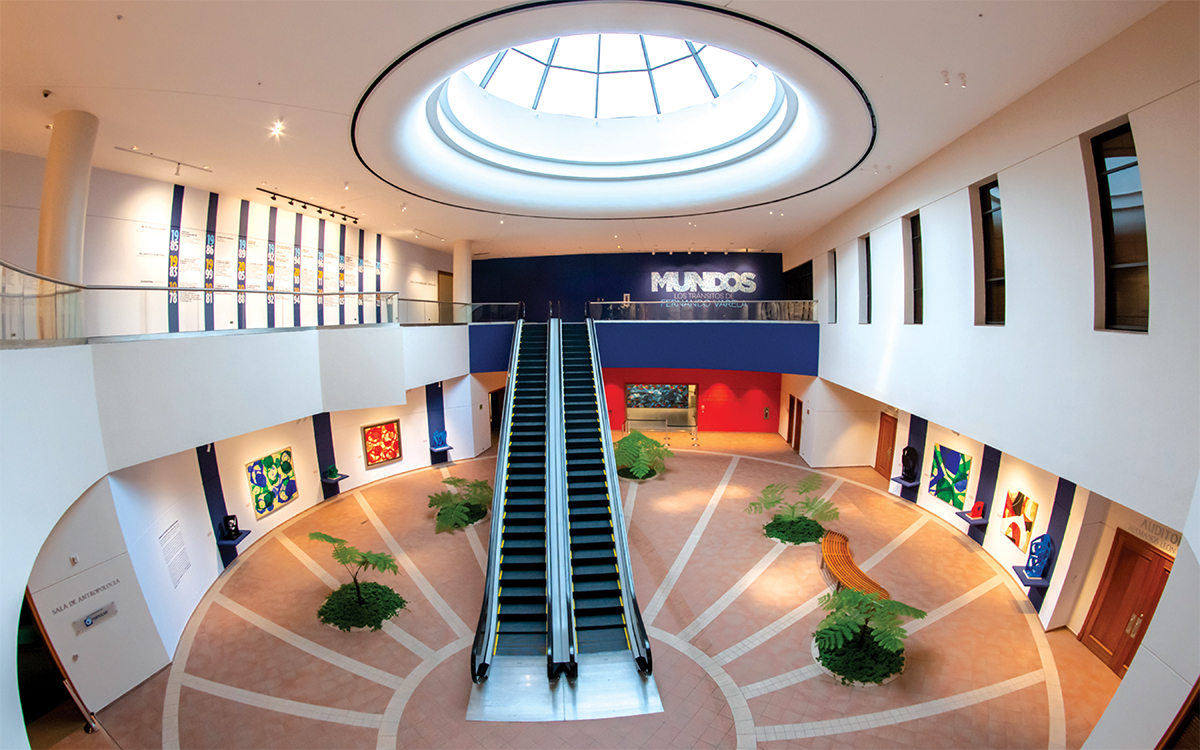
Perfectly lit and well-appointed galleries gave Fernando Varela's works the aesthetic dimension they deserved. Clarity, spaciousness, the harmonious arrangement of two-dimensional and three-dimensional elements, and necessary yet sufficient texts define the museographic approach, encouraging observation without resorting to ostentatious staging. There is an optimal harmony between the exhibited pieces, the environment, and the installation—a hallmark of the Centro León and a privilege to exhibit there!
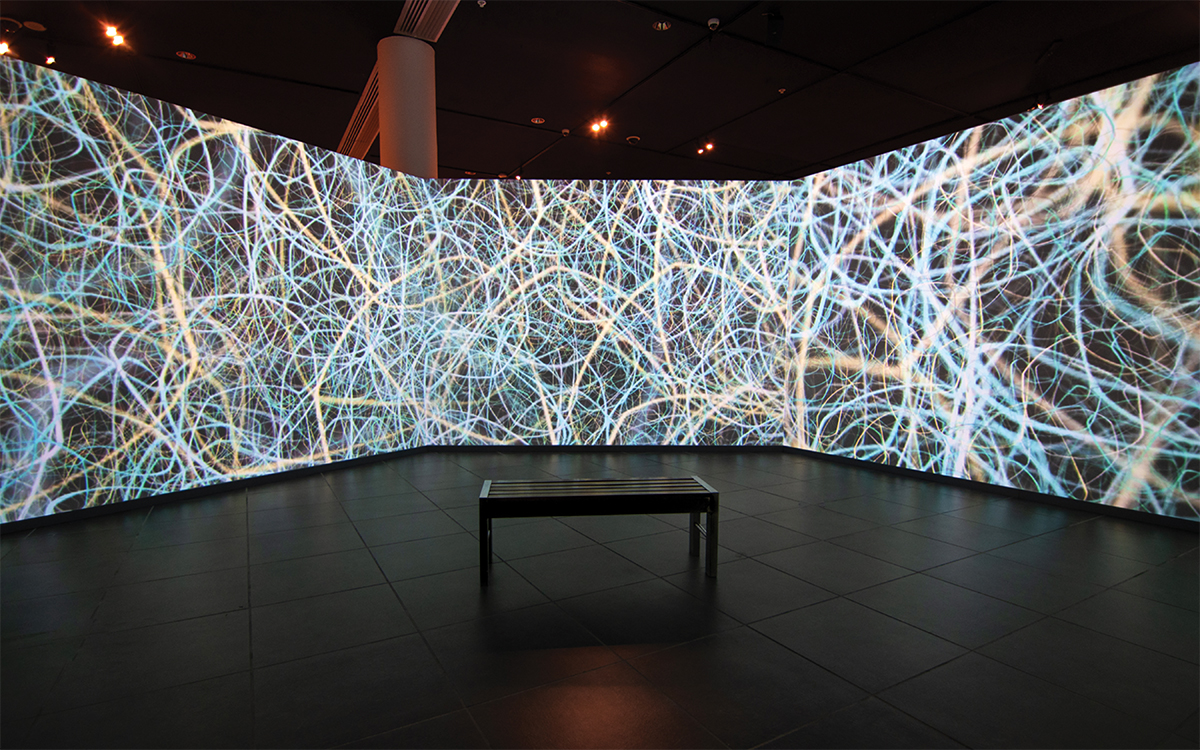
Fernando Varela, whose towering reputation does not exalt the song of color, can nevertheless achieve a luminosity—exciting, yes!—of almost “arbitrary’ colors, as in the magnificent installation that opens the exhibition in the lobby of the Center, and, nearby, if memory serves, that vibrant painting, which seemed to be reflected on the floor…
While Fernando Varela has become Dominican and immersed himself in the tropics and Caribbean culture, his desire to preserve his native identity is clearly evident in the first decade of his work, and even afterward. We affirm that Joaquín Torres García, Uruguayan and universal, has left his mark—constructivist and symbolist, spiritual and aesthetic: every good artist has parents and ancestors.
Not infrequently, due to the narrow-mindedness of certain local sectors, or rather their complexes, these Uruguayan roots have been objected to, instead of being considered part of the originality and solidity of the expression as a professional pattern.
A pluralistic and coherent creator
In Fernando Varela's work, regardless of its category, whether two-dimensional or three-dimensional, nothing is left to chance; everything is the fruit of reflection, of careful combination of elements, of precise adjustments to lines and tones. This self-discipline and precision have always been evident and continue to this day.
Let us remember that one of the artist's most powerful exhibitions was presented in all the spaces of the Spanish Cultural Center, then directed by Ricardo Ramón Jarne, and that display of installation, painting, sculpture, ceramics, in our opinion, gave rise to his complete, committed, future-oriented creation, which unfolds in the León Center.
The active participation of the viewer completes the artistic proposal: an indifferent and superficial contemplation would not be able to appreciate this retrospective of 61 pieces.
It is our meticulous interest—for example, in the portraits of Joseph Beuys—that compels us to linger and discover the transcendent reason for that choice, a combination of affinity and contrast. A profound motivation is never lacking, regardless of the means employed or the era in which the work was created.
Therefore, in this exhibition, avoiding opposing or linking the figurative and abstract aspects, we will remember the very personal geometry of Fernando Varela, which began with simple and archaeological morphologies, and has been enriched over the years, without losing its "sensitive" quality.
Divided surfaces, points, squares, circles, spheres, ovals—in short, quadrangular and curvilinear geometric forms—continued to structure the plastic support, but the spiral, the labyrinth, the mosaic, and diverse graphic elements gradually gained importance. Beyond interior design and permanent equilibrium, they contain their own messages of peace, order, and elevation. The evocation of the mandala, as a cosmic symbol of supreme harmony, is inevitable.
Physical representations can be striking in their uniqueness, such as hands and muscles—as depicted in paintings or modules—but we value them less as representative than signs, symbols, or sources of meditation. They could be other, less carnal, parts or visions of the body.
Nevertheless, Fernando Varela insists on the human being, their solitude and uniqueness, even in the relationship between man and woman. The Caribbean island—to which the artist now belongs—also “isolates”: communication is situated on another level. Here, more important than the individual as a physical presence is the ontological allegory. Consistently, refinement and austerity characterize Fernando Varela's painting: each era requires a deliberate reading, from the design to the chromatic subtlety, never a furtive glance.
At the Edge of Time
There is no shortage of works from the unforgettable “Silent Word,” signs that arouse curiosity and unease. We continue to consider them, more than plastic compositions, as graphic decompositions, choosing to privilege numbers, letters, rhythms, and not the word itself. Could it be that Fernando's mind questions the text, as it once did… curating?
Moving forward in time, while Fernando Varela's interior landscapes have always predominated, he also addresses, in his own way, the tropical landscape, delineating it, detailing it, "toning" it, and once again transforming it into signs with a subtle illumination. Our only minor objection is that the enchanting white crocodiles are missing; perhaps they were discarded because of their "disruptive" effect.
Finally, paintings, sculptures, and installations—all masterful without exception—described by the artist himself as “Form and Void,” and three-dimensional explorations of space, conclude Fernando Varela’s “Worlds,” whose journeys will continue… in a perpetual search for “meta-physical” propositions, even though they necessarily materialize for our enjoyment. In short, the Centro León hosted and organized a subtly impactful, unique, and unforgettable exhibition.
.“My work, which is recurrent in its use of the symbol as a revealer of knowledge, always relies on silence, because the power of the symbol avoids the superfluous and always needs silence to reveal its ultimate meanings.”
– Fernando Varela«"Varela's cosmology is highly educated; if he weren't a master of color, form, and matter, if it weren't for the aesthetic power of his works, we would say that Varela doesn't paint, he writes and composes music."
Ricardo Ramón Jarne
Former director of the Spanish Cultural Center